February 3, 2026
Streamlining the Future of Air Travel
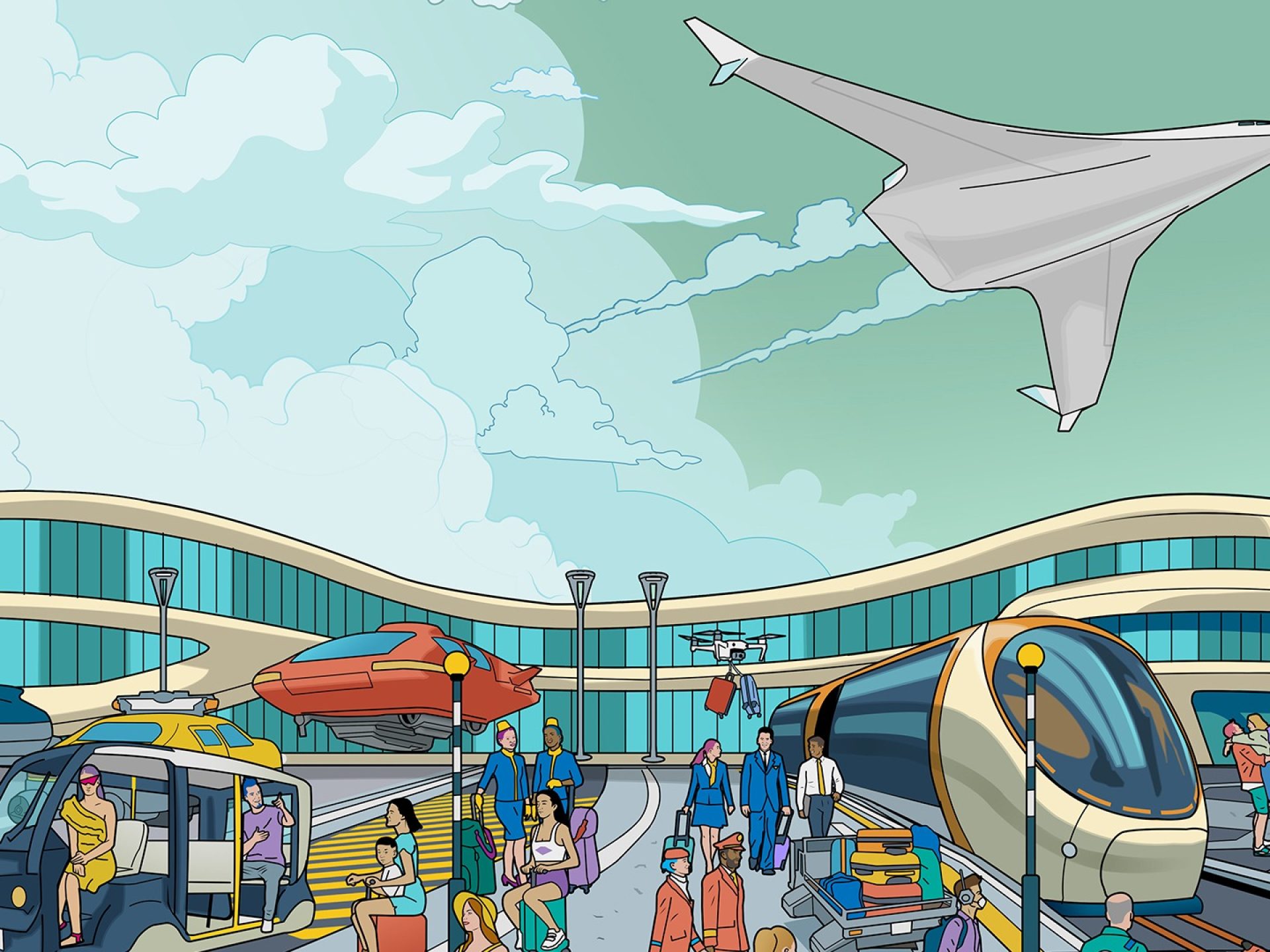
At any time of day, thousands of aircraft buzz through the skies above our heads, ferrying their millions of passengers to every corner of the world. And the numbers are growing sharply. According to Airports Council International, in 2025, nearly 10 billion airline passengers took to the air, a figure predicted to more than double to 23.3 billion by the middle of the century.
All these travelers require larger and more efficient airports. Airport design is an area Populous is now addressing more than ever, following its acquisition of specialist airport designers Fentress Studios.
Curtis Fentress is founder and principal in charge of design at the company. He envisages future airports where passenger engagement is paramount, whether that’s retail, catering, leisure or entertainment.
“Flight delays and cancellations caused by weather, labor shortage, gate allocation delays, ground handling issues, and tight aircraft rotations are routine,” he explains. “How do we take care of passing time for the passenger? In my view, that’s where Populous’ expertise in environmental and experiential design comes in.”
Bruce Miller, global chairman and CEO at Populous, agrees. He sees no reason why large, public entertainment arenas, like The Sphere in Las Vegas—which his company designed—shouldn’t be installed in airports, offering delayed passengers access to movies, concerts or theatrical shows, for example.
“Could you perhaps bring immersive experience elements like that to an airport?” he asks. “Could you bring an interactive art museum to an airport? There are lots of opportunities to make dwell times more entertaining and educational.”
Many existing airports have already become destinations in their own right. Singapore Changi Airport, for example, offers a nature-themed entertainment and retail complex called Jewel which includes gardens, visitor attractions, a hotel, retail, dining and the world’s tallest indoor waterfall—all spread out across 1.46 million square feet (136,000 square meters) of floor space. Hamad International Airport, in Qatar, has capitalised on its location as a major transit hub, halfway between Europe and the Far East. Thanks to facilities such as a 65,000 square foot (6,000 square meter) tropical garden, a wellbeing and fitness centre, a Middle Eastern-style souk and a mosque, it was voted world’s best airport by airline consultancy Skytrax.
Like Changi and Hamad, many of the world’s top airports are now attempting to revive the lost glamor of international travel. Drawing passengers in are high-end restaurants designed by world-famous chefs, premium-class lounges with facilities such as saunas, spas, gyms and sleeping areas, and fashion and beauty retail outlets to rival some of the best-known shopping avenues in major world cities; all very attractive and convenient for passengers from regions where such facilities are rare.
“Using design as a tool to create memorable and engaging experiences is a golden thread that runs through our work across all sectors. Traditionally, airports have served a utilitarian function—simply points of transience through which passengers pass on their journeys from point A to point B. We are redefining that model by envisioning the airport itself as a destination in its own right.”

Advances in wireless technology will bring huge benefits to airports, ensuring that passenger movement through terminals is faster and less stressful. Automatic passport scanning already exists. But what about facial recognition in the security checking areas? Or luggage handling services that transport passengers’ bags directly from their homes to their final destinations?
Dubai International Airport has already unveiled an AI-powered passenger corridor which clears immigration in under 15 seconds using facial recognition and pre-registered biometric data. “No passports, no manual checks, just a seamless walk through, while artificial intelligence silently scans and confirms details,” explain the airport operators. “Any anomaly gets flagged immediately for human review.” The goal is to phase out traditional passport control altogether.
As Fentress says: “We’re moving toward touchless, frictionless experiences, which require a significant technological infrastructure. When we design for the future, we’re not just thinking about aesthetics—we’re thinking about buildings that can support that future tech seamlessly.”
What about the aircraft themselves? The switch from fossil fuels to electricity-powered airplanes is inevitable. In addition to this, Fentress envisages smaller electric aircraft that will transport passengers directly from their homes to the airport terminal, allowing them to skip surface transport altogether.
Huge cities like London, Tokyo or New York usually have several international airports serving them. Fentress believes these disparate airports will effectively become one giant metropolitan hub, with small electric aircraft offering rapid air connections between them. “These localized networks will be far more time-saving, cost-efficient and sustainable than other modes like cars and trains,” he adds.
As well as being greener, the aircraft of the future will be much faster. Many manufacturers are currently developing supersonic passenger aircraft which will cut down enormously the journey times across and between continents.
Fentress and his colleagues at Populous hope that future airport buildings will be far more robust than the current ones. “Traditionally, airport facilities were designed to last 20 or 30 years before being torn down and replaced,” he explains.
“We don’t have the luxury of waiting to see what the future will bring. We need to design buildings that are flexible and adaptable, with the potential to last 75 years or more. These are expensive investments. Making them last longer adds real value for our clients.”
Ultimately, though, just as they do with their stadia and arenas, Populous wants to design buildings that customers love. “When people feel a connection to a building—when there’s an emotional or aesthetic resonance—they take care of it,” Fentress concludes. “We’ve seen that in our past projects. If people love the space, they want it to last beyond its intended lifespan.”
Now part of Populous, Fentress Studios, based in Denver, Colorado, specialize in aviation projects. Previous designs include Denver International Airport and Incheon International Airport.


Lorem ipsum dolor sit amet consectetur, adipisicing elit. Non facere corporis et expedita sit nam amet aut necessitatibus at dolore enim quis impedit eius libero, harum tempore laboriosam dolor cumque.
Lorem, ipsum dolor sit amet consectetur adipisicing elit. Illo temporibus vero veritatis eveniet, placeat dolorem sunt at provident tenetur omnis, dicta exercitationem. Expedita quod aspernatur molestias eum? Totam, incidunt quos.